
RSCDS Brighton Branch
Frequently Asked Questions or FAQs
- Do I need a partner?
- Is it good exercise?
- Is there an age limit?
- Can I dance over swords?
- Do I need special shoes, tartan or a kilt ?
- What is your Safeguarding (Child Protection) policy?
- What is your Privacy (Data Protection) policy?
- Do I have to learn all the dances by heart?
- Do I have to be Scottish?
- How much does it cost?
- What are the benefits of full membership?
- How can I become a full member?
Do I need a partner? - No
 No. Usually in Scottish country dancing, dancers take a different partner for each dance. This adds to the social nature of the dancing, and means that you get an opportunity to meet and dance with lots of different people.
Nearly all Scottish country dances need at least six people to dance together. And ladies can ask men to dance as well!
No. Usually in Scottish country dancing, dancers take a different partner for each dance. This adds to the social nature of the dancing, and means that you get an opportunity to meet and dance with lots of different people.
Nearly all Scottish country dances need at least six people to dance together. And ladies can ask men to dance as well!
Is it good exercise? - Yes!
Yes! Like most types of dancing, Scottish country dancing is excellent, healthy exercise. And the fitter you are the easier it will be to learn.Dancing is very good for your heart and lungs and will improve your balance and bone density as well. Studies have shown Scottish country dancers to have more agility, stronger legs, and to walk more briskly than other fit people. See articles by the RSCDS The health benefits of SCD and The Scotsman, 12 January 2014, Scottish dancing can help keep old age at bay.
We encourage warming up before class and stretching afterwards. But it's not just exercise to keep you fit - you can dance to to great music and have fun at the same time.
Go to the top of this page
Is there an age limit? - No
As long as you are willing to have a good time there is no upper limit on age. We are qualified to teach anyone aged 6 to 106. All you need is to enjoy dancing.
 Can I dance over swords? - Yes
Dancing over swords to the sound of the bagpipes is Highland dancing. Use the menu on the left to find out about the Highland Dance style and our highland classes.
Do I need to wear special shoes, tartan or a kilt? - Yes and No
Yes - shoes are important. You should wear comfortable shoes with a soft, non-slip sole, such as jazz, ballet shoes or soft-soled trainers. After a few dance evenings most people decide to buy a pair of soft dancing shoes designed specifically for Scottish Country Dancing: leather pumps or ghillies. Some venues might require you to wear soft shoes to protect the floor so be prepared to remove heavy street shoes and dance in socks.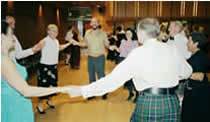 And No - the main thing is to wear clothes that feel comfortable and let you can move easily.
Men who choose to wearing the kilt find it comfortable for dancing, but it is not essential.
Ladies often choose to wear a wide skirt, which can be more comfortable and easier to dance around in. For demonstrations and formal balls, a tartan sash over the shoulder or even a traditional dress is sometimes worn.
What is your policy for safeguarding children and vulnerable adults?
We take all reasonable steps to ensure that children and vulnerable adults taking part in our activities do so in a safe and secure environment. When children come to our country classes, we ask that a responsible adult accompanies them and dances with them as their partner if they can.In the highland class there is always another adult present as well as the dance teacher, and when children take their exams we ensure they are not left unattended in the exam hall with the examiner, since the examiner is a 'stranger' to the child despite being DBS checked.
Go to the top of this page
Do I have to study for years before I can join dances or balls? - No
No. TWe pay more attention to steps (footwork) than in ceilidh dancing, and the formations can be a little more complex, but the basic technique can be learned at our weekly classes, at a local dance workshop or at dance weekends organised by RSCDS "HQ" in Scotland.Do I have to learn dances by heart?
No. You don't have to learn any of them by heart if you don't want to, although you should try and learn the steps and formations. Programmes for balls and social dances are published well in advance and weekly classes aim to practise the dances from forthcoming programmes. Also, at the event itself dances are often recapped (always recapped at our Branch dances) or even walked through before the music starts.Go up to the top of this page
Do I have to be Scottish?
No. Scottish Country Dancing is enjoyed the world over, across Europe and North America to Australasia and Japan, by anyone who just loves to dance. There are now more people doing SCD outside Scotland than in it, although in Scotland, people have the advantage of learning it in school.Go to the top of this page
How much does it cost?
Class fees are £3 for children and £4 for adult members, £5 for adult non-members. Annual branch membership costs around £30 a year - see the last section below on How to join as a member.Saturday Scottish balls and dances cost between £7 and £20.
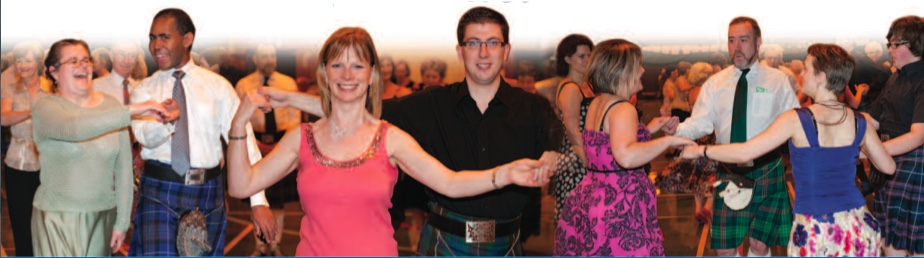
What are the benefits of paying to join the RSCDS?
Apart from reduced class fees, the regular RSCDS magazine and being able to attend the international RSCDS Winter School and Summer School, you are contributing to the future of Scottish Country Dancing worldwide. RSCDS supports SCD by:* publishing books of dances and co-ordinating the SCD repertoire
* training teachers
* running courses for musicians and publishing CDs of dance music
* Youth work, medal tests and the annual Spring Fling
* supporting branches / affiliated groups and listing them online so holiday-makers and other travellers can find us - and will be very welcome to dance with us whenever you are passing by.
See also the RSCDS HQ member benefits web page.
How can I become a member?
Download and print the new member application form (or renewal form if you are already a member). Fill it in and pass it with your remittance to your teacher, our treasurer, or any member of the committee.Annual membership of Brighton Branch costs no more than the RSCDS HQ subscription, currently based on £30 for one adult.
Go to the top of this page